



Mold Release Agents
Industrial Mold Release Agents & Sprays
Mold release agents do more than prevent sticking. The right industrial mold release keeps your production moving, your parts coming out clean, and your molds in better condition, longer.
The wrong one costs you:
- Scrapped parts and rework
- Lost cycle time from sticking and tearing
- Buildup that slows production and damages mold surfaces
- Inconsistent results between runs, shifts, and operators
- And much more...
Stoner Molding Solutions has spent nearly 80 years solving exactly these problems for industrial manufacturers across plastics, rubber, polyurethane, and composites
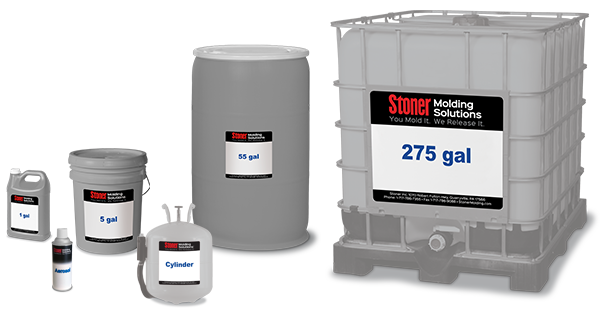
Stoner's mold release coatings are available in many sizes and application types.
Why Stoner Mold Release Agents?
Stoner Molding Solutions engineers industrial mold release agents for one purpose: keeping your production running at full capacity. Our formulations are built around your process, not the other way around.
Nearly 80 years of hands-on experience means our PhD chemists and molding experts have seen your challenges before. They work directly with your team to match the right mold release chemistry to your material, mold, and production goals.
The Stoner line of mold release agents includes:
- Conventional (or sacrificial) coatings
- Coatings designed for post-decorative or bonding applications
- Semi-permanent mold release technology for multiple releases per application
Talk with a Molding Expert Today!
Our industry-leading experts, chemists, and engineers are here to listen and provide honest value. We’ll help you troubleshoot your process and recommend the right products for your needs. We can even work with you to create custom formulations tailored to meet your production requirements.



Frequently Asked Questions About Mold Release Agents
Have questions about mold release agents, mold release chemistry, or finding the right product for your process? We've answered the most common questions our industrial customers ask below.
A mold release agent is a substance applied to a mold surface to prevent the molded material from bonding to the mold, allowing the finished part to be removed cleanly after cure or solidification. Mold release agents are used across plastics, rubber, polyurethane, and composites manufacturing.
Mold release agents work by creating a thin barrier layer between the mold surface and the molding material. This barrier reduces adhesive forces between the two surfaces, allowing the cured part to release without tearing, sticking, or surface damage. Depending on the mold release chemistry, the release film may be sacrificial (applied each cycle) or semi-permanent (lasting multiple cycles).
Sacrificial mold release agents are re-applied to the mold before each cycle or shot. Semi-permanent mold release agents form a durable film on the mold surface that allows multiple part releases per application before recoating is needed. Semi-permanents reduce reapplication frequency and are preferred in high-volume industrial production environments.
Common mold release chemistry types include fluoropolymers, PTFE, silicone (polysiloxanes), wax-based compounds, zinc stearate, and water-based or solvent-based carrier systems. Chemistry selection depends on the molding material, mold substrate, required surface finish, and downstream part use.
Industrial mold release agents are used across plastics (injection, blow, rotational, and thermoforming), rubber molding, polyurethane molding, and composites manufacturing including carbon fiber and compression molding. Stoner Molding Solutions serves all of these industries with dedicated mold release products for each application.
The best injection molding release agent depends on your specific thermoplastic material, mold geometry, cycle time, and surface finish requirements. Stoner offers silicone-based, silicone-free, PTFE, and fluorochemical mold release agents for plastic injection molding applications. Contact our technical team for a recommendation specific to your process.
Semi-permanent mold release agents are the right choice when you are running high-volume production and need to reduce reapplication frequency, lower per-part labor costs, and improve release consistency across long runs. Stoner's semi-permanent industrial mold release formulations are available for composites, rubber, and polyurethane applications.
Reapplication frequency depends on the mold release product type and your specific process. Sacrificial mold release agents are applied every cycle. Semi-permanent mold release agents may last for multiple cycles depending on the chemistry, mold condition, and molding material. Your Stoner technical representative can help you determine the expected release life for your application.
A mold release agent is applied to the mold surface to prevent part adhesion during molding. A mold cleaner is used to remove buildup, residue, and contamination from the mold surface between production runs or during maintenance. Both are important parts of a well-maintained molding operation, but they serve different functions and should not be used interchangeably.
Yes. Stoner Molding Solutions has in-house PhD chemists and full formulation-to-distribution capability. When standard mold release products do not meet your specific process requirements, our team can develop a custom industrial mold release formulation tailored to your mold material, molding process, and production environment.
Shop Mold Release Products
Stoner Molding Solutions formulates, manufactures, and distributes our own mold release products from start to finish. Browse our full line of mold release agents, mold release sprays, sealers, cleaners, rust preventatives, and lubricants. In-stock products ship now.